Showing posts with label John Michael Montgomery. Show all posts

Tuesday, December 12, 2023

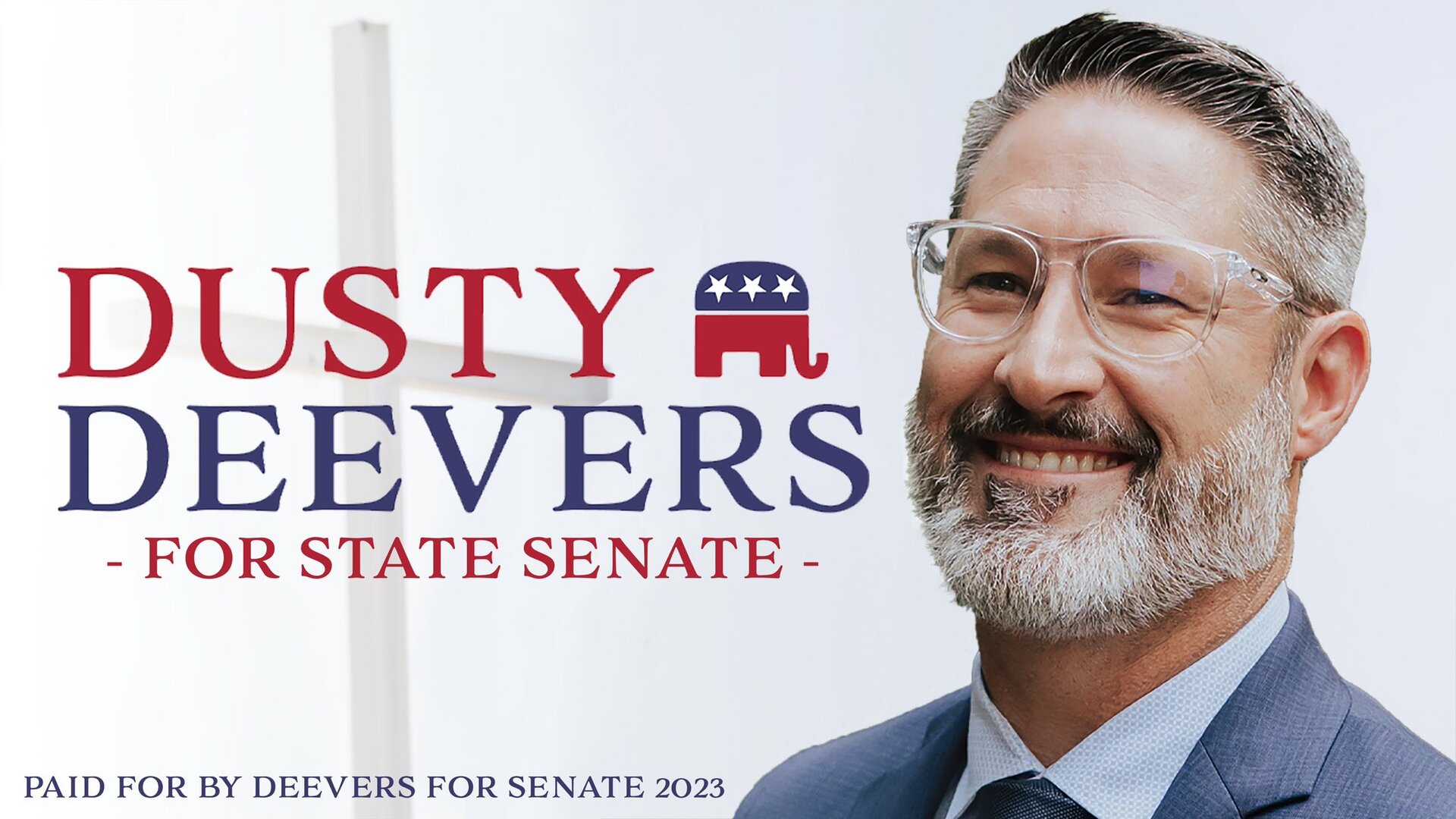
GOP hold: Dusty Deevers wins SD32 special election


The voters in Oklahoma State Senate District 32 have spoken, and chosen Republican Dusty Deevers to fill the remainder of former Senator John Michael Montgomery's four-year term, which expires in 2026. Deevers received 3,104 votes (55.48%) to Democrat Larry Bush's 2,491 votes (44.52%).

A Baptist pastor from Elgin, Deevers is an unabashed conservative who has been very involved in efforts to abolish abortion not only in Oklahoma, but across the country. 

The last competitive election in this district was in 2018, when Republicans took the seat for first time since the 1930s, when John Michael Mongtomery received 55.14% over Democrat Jacobi Crowley's 44.86%.

Saturday, August 05, 2023

Pastor Dusty Deevers announces candidacy in Oklahoma Senate District 32 special election


The recent resignation of State Sen. John Michael Montgomery has triggered a special election in State Senate District 32. Six candidates - four Republican, two Democratic - filed for this seat in the Lawton area, which has been held by Republicans since 2018. The winner-take-all primary election will be October 10th, with the general election on December 12th.

One of the four Republicans is a man of stellar character and conservatism, Dusty Deevers.

Wednesday, July 12, 2023

State Sen. John Michael Montgomery resigns to take lead role at Lawton Chamber of Commerce

State Sen. John Michael Montgomery is resigning to head up the Lawton Fort Sill Chamber of Commerce. He becomes the second legislator in the past six years to resign to lead a local Chamber (the last being State Rep. Scott Martin resigning to join the Norman Chamber).


Sen. Montgomery announces resignation, accepts new role with Lawton Chamber

OKLAHOMA CITY – Sen. John Michael Montgomery, R-Lawton, released the following statement Friday after announcing that he will be resigning from the Oklahoma Senate, effective Aug. 1, 2023, to accept the role of president and CEO of the Lawton Fort Sill Chamber of Commerce.

Monday, June 20, 2022

Small: Reality check for Cherokee leaders may be positive sign

Reality check for Cherokee leaders may be positive sign
By Jonathan Small

The U.S. Supreme Court’s McGirt decision, which effectively declared much of eastern Oklahoma remains tribal reservation land, prompted some tribal officials to embrace separatism.

In 2021, a Muscogee (Creek) Nation official told NonDoc the difference between the Muscogee chief and the governor of Oklahoma is that one is the “head of a nation” while the other is “just the head of the state.”

That’s grandiose, at best. David Hill was elected Muscogee principal chief with 3,399 votes. Kevin Stitt was elected Oklahoma governor with 644,579 votes.

On a similar note, Cherokee Nation Principal Chief Chuck Hoskin, Jr. recently banned display of the Oklahoma flag on Cherokee property. But Hoskin’s action drew swift rebuke from other Cherokees. [see article here]

When announcing he was reversing course, Hoskin said he had “heard from many Cherokee citizens” and “the vast majority were opposed” to his flag order. Many were concerned it “further divided the state and the tribe.”

Put simply, there was a huge gap between Cherokee leadership and Cherokee citizens, most of whom do not view their home state with hostility.

It’s not shocking that gap exists. Few Cherokees are directly involved in tribal government. The tribe reports over 400,000 individuals are Cherokee citizens, but less than 14,000 voted in the last election for tribal chief. (Similar trends are also notable for the Muscogee Nation, which claims 86,100 citizens.)

Most Cherokees don’t embrace a worldview pitting them against their non-Indian neighbors and family members.

That contrasts with many comments from some tribal leaders. When the Oklahoma Council of Public Affairs called for McGirt to be reversed, which would simply ensure all Oklahomans are treated the same under the law as had been the case for the prior century, Muscogee leadership responded with “see you on the battlefield.”

The Muscogee (Creek) Nation now argues all Muscogee citizens living on the tribe’s reservation—including most of Tulsa—are exempt from state taxes. Hoskin has also indicated support for that position. If that view prevails, it could reduce state funding for things like roads and schools by more than $200 million, if not more.

As state Sen. John Michael Montgomery has noted, if tribal citizens don’t pay Oklahoma taxes “there’s a pretty compelling argument to be said: ‘Why are we still funding things in areas if they’re not going to be paying taxes on services for those areas?’”

The challenges created by McGirt extend well beyond flag displays. Rather than equal treatment, what is occurring under McGirt is different treatment based on heritage and physical location—and that disparate treatment is harming people, including tribal citizens.

Most Cherokees understand we are all Oklahomans, even if some of their leaders do not. If those Cherokee citizens’ view prevails, the challenge of working out state-tribal differences will become much easier.

Jonathan Small serves as president of the Oklahoma Council of Public Affairs

Monday, November 08, 2021

Cherokee Chief says no Oklahoma income tax for tribal citizens


CHEROKEE CHIEF SAYS NO OKLAHOMA INCOME TAX FOR INDIANS

Cherokee Nation Principal Chief Chuck Hoskin, Jr., said the U.S. Supreme Court’s decision in McGirt v. Oklahoma significantly increases the number of American Indian citizens who may now be exempt from paying Oklahoma state income tax.

“There’s nothing new about the law out there on the ability of a state to tax a member of a federally recognized tribe on a reservation,” Hoskin said. “What’s new of course is the scope of the reservation (because) of the McGirt case. So, we can look to existing law and we can see that taxation doesn’t attach to individual Native Americans who live on reservations.”

Hoskin made those comments as part of a panel on state tax-and-budget issues hosted by the Oklahoma Policy Institute.

The McGirt ruling found that the Muscogee Nation’s reservation was never disestablished. The ruling has since been expanded to include the reservations of the Choctaw, Chickasaw, Cherokee, Seminole, and Quapaw, a combined area that covers nearly half of Oklahoma. The affected area is home to roughly 2 million people of which 21 percent are estimated to be American Indian.

Members of federally recognized tribes have long been exempted from various forms of state taxation—if they live and work on tribal land. Prior to McGirt, that exemption covered only a small share of individuals working on much more geographically confined areas directly owned by Oklahoma tribal governments.

But under McGirt most of eastern Oklahoma is now considered reservation land, regardless of current ownership, potentially expanding the tax exemption to many more individuals. Hoskin conceded that may result in “revenue gaps” for state government.

Because of potential exemptions for tribal members on reservation land, the Oklahoma Tax Commission previously estimated that the McGirt decision could slash Oklahoma state tax collections by $72.7 million per year from reduced income tax collections and $132.2 million annually from reduced sales/use tax collections.

However, that estimate was based on McGirt applying only to the Muscogee, Choctaw, Chickasaw, Cherokee, and Seminole tribes. The Quapaw reservation has since been declared to have never been disestablished, and similar rulings could occur for other tribes now litigating reservation status.

Saturday, March 07, 2020

Legislation to increase income qualifier for additional Homestead Exemption passes house


Legislation to Increase Income Qualifier for Additional Homestead Exemption Passes House

OKLAHOMA CITY – State Rep. Lonnie Sims (R-Jenks) passed legislation to update the statutory income qualifier to claim an additional homestead exemption through the Oklahoma House of Representatives. The qualifier has not been raised since 1997.

House Bill 3653 increases the statutory income qualifier to claim an additional homestead exemption from $20,000 to $25,000. The additional homestead exemption reduces, by $1000, the assessed valuation on the homestead of a homeowner whose gross household income is below the income qualifier limit.

Sims said that current statute outlines that after age 65, Oklahomans who previously qualified for the exemption are no longer required to file annually, but many retired Oklahomans still do. This puts local tax assessors in a position of having to take away the exemption when informed that the homeowner’s income has increased above the current qualifier of $20,000.

“Many retired Oklahomans, for no reason other than simply being honest, are now losing this exemption because of the Social Security income cost-of-living adjustments received over the past 23 years,” Sims said. “This has pushed their income beyond the current qualifier and it’s certainly time for an adjustment so they can keep this small benefit.”

On average, the double homestead exemption results in a savings ranging from $87 to $137 annually.

Pontotoc County Assessor Debbie Byrd, who alerted Rep. Sims to this growing concern, explained that this legislation is critical for the retired and low income homeowners of Pontotoc County who once again may be able to quality for the exemption.

“The small tax savings may not seem like much, but it may cover the groceries for the month or keep the heat on,” said Byrd. “It’s not often local assessors get to aid the legislative process for our State, and I am grateful for the work Rep. Sims and Sen. Montgomery are doing to make sure our taxpayers in most need are never forgotten.”

House Bill 3653 is authored in the Senate by Sen. John Montgomery (R-Lawton). After passing the House 97-0, the bill is now available to be considered in the Senate.

Thursday, April 18, 2019

Stitt signs bill to increase speed limits on turnpikes, certain highways


Governor Signs Bill to Increase Speed Limits on Turnpikes, Highways

OKLAHOMA CITY – Gov. Kevin Stitt today signed a bill into law that will increase the speed limit on Oklahoma turnpikes from 75 to 80 miles per hour and on certain state highways from 70 to 75 miles per hour.

Rep. Daniel Pae, R-Lawton, is the House author of House Bill 1071. Sen. John Michael Montgomery, R-Lawton, is the Senate author.

Pae, serving his first term in the Legislature, said he worked with the Oklahoma Department of Transportation, the Oklahoma Turnpike Authority and the Oklahoma Highway Patrol on the language of the bill and gained their support. He joked the bill had become known as the Pae-Way Bill.

“While we wanted to increase the speed limit on our turnpikes and state highways, we also worked to ensure the safety of Oklahoma drivers,” Pae said. “We will use traffic and engineering studies that take into consideration things such as traffic density and infrastructure quality to determine where we could safely increase these speed limits.”

Pae said the speed limits in the bill will be implemented gradually, sensibly and safely.

Pae also worked with the Oklahoma Department of Transportation and the Oklahoma Secretary of Transportation to include language in the bill pertaining to traffic studies to keep the state in line with federal regulations so we can continue to receive federal highway dollars.

This was Pae’s first bill to be signed into law.