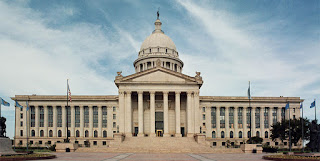
Two weeks ago, I published Here's what you need to know about the judges on Oklahoma's 2026 ballot. In this post, I'll focus in on the two state questions that are on the ballot. I got some of my information from these helpful articles (SQ 845, SQ 847) at Ballotpedia, in addition to information from various blogs and sites.

• The good news you need to know
• Sign up for the MuskogeePolitico Email Newsletter
• Get up to 25¢/gallon back with Upside, plus other savings apps
• Here's what you need to know about the state questions on the 2026 ballot
Monday, October 26, 2026
Friday, October 09, 2026
Rep. Gann: Greater reforms needed to deliver true property-tax relief
Rep. Gann: Greater Reforms Needed to Deliver True Property-Tax Relief
INOLA, OK (Sept. 28) – State Rep. Tom Gann today said State Question 847 may slow future increases in taxable property values, but Oklahoma cannot deliver true property-tax relief without reforming the corporate exemptions, reimbursements and tax increment financing districts that shift public costs onto homeowners and other taxpayers.
Beginning in 2027, SQ 847 would reduce the maximum annual increase in taxable value from 3% to 1.75% for homestead and agricultural property and from 5% to 4% for most other real property. It also would establish lower, income-based valuation caps for certain homeowners age 65 and older.
“SQ 847 may slow the property-tax escalator, but it does not turn it off,” Gann said. “It will not reduce anyone’s current tax bill, cap millage rates or prevent new bond levies. More importantly, it does not address the preferential tax treatment government provides to selected businesses.”
Sunday, November 03, 2024
Sen. Deevers on why voters should reject State Question 833
The following is a column by State Sen. Dusty Deevers (R-Elgin) about the dangers of State Question 833. I concur:
Rejecting Oklahoma SQ 833 – The Case Against Public Infrastructure Districts (PIDs)
Originally posted at OKGrassroots
State Question 833 (SQ 833) introduces Public Infrastructure Districts (PIDs), giving developers significant control over infrastructure financing at taxpayers’ expense. Here’s why voters should say “No” to SQ 833.
Sunday, October 27, 2024
Here's what you need to know about the State Questions on Oklahoma's 2024 ballot
Thursday, July 18, 2024
Muskogee City Council backtracks, postpones $78M bond issue, sales tax renewal
Back in May, the Muskogee City Council voted to set an August 27th election for a $78.6M general obligation bond and sales tax proposal. It had a rushed feeling to it, and there's been quite a bit of local controversy over it. Earlier this week, the council held a special meeting and voted to postpone to vote for further community input.
Good.
MUSKOGEE, OKLA., July 15, 2024 - In a Special Call City Council meeting held on Monday, July 15, the Muskogee City Council voted to postpone the upcoming General Obligation Bond Election.
“Almost everyone I’ve talked to is in favor of investing in Muskogee and likes the projects put forward, but I feel like we could use a few more months to consider the issues,” said Mayor Patrick Cale.
Tuesday, May 21, 2024
Muskogee City Council sets August vote on $78M bond issue, sales tax renewal
![]() |
| County Assessor Ron Dean during public comment at the Muskogee City Council meeting Monday |
Brace for impact, Muskogee: our city council has set an election for a bond and sales tax proposal totaling over $78,000,000 on August 27th.
I dropped in for my first city council meeting in years yesterday when I heard that a special meeting had been called to vote on sending the mega-million dollar package to the ballot. You can view the agenda here; scroll down to items 14, 15, 16, and 17.
Wednesday, February 01, 2023
Rep. Gann files bill to require vote of the people to redirect property taxes to TIF districts
OKLAHOMA CITY (Jan. 31st) – Rep. Tom Gann, R-Inola, has filed House Bill 1379, which would require a vote by citizens to redirect property tax through Tax Incremental Financing (TIF) Districts.
Gann explained that in Mayes County, Mid-America Industrial Park (MAIP) officers proposed redirecting county property tax through the implementation of a TIF district to benefit new corporations coming into the industrial park.
Tuesday, July 19, 2022
Legislators file initiative petition for state question on freezing property tax for seniors
Legislators File Petition to Add Senior Homestead Fair Cash Value Freeze State Question to Ballot
OKLAHOMA CITY – A trio of state representatives recently filed an initiative petition to add an amendment to the state Constitution that would freeze the homestead fair cash value for individuals aged 65 and older.
If enough signatures are gained (177,958 are needed), State Question 822 could be on the Nov. 8 ballot this year. The initiative petition was filed June 24 by Reps. Max Wolfley, R-Oklahoma City; Eric Roberts, R-Oklahoma City; and Robert Manger, R-Oklahoma City. A challenge period ended July 15.
Wednesday, May 25, 2022
Saturday, March 07, 2020
Legislation to increase income qualifier for additional Homestead Exemption passes house
OKLAHOMA CITY – State Rep. Lonnie Sims (R-Jenks) passed legislation to update the statutory income qualifier to claim an additional homestead exemption through the Oklahoma House of Representatives. The qualifier has not been raised since 1997.
House Bill 3653 increases the statutory income qualifier to claim an additional homestead exemption from $20,000 to $25,000. The additional homestead exemption reduces, by $1000, the assessed valuation on the homestead of a homeowner whose gross household income is below the income qualifier limit.
Sims said that current statute outlines that after age 65, Oklahomans who previously qualified for the exemption are no longer required to file annually, but many retired Oklahomans still do. This puts local tax assessors in a position of having to take away the exemption when informed that the homeowner’s income has increased above the current qualifier of $20,000.
“Many retired Oklahomans, for no reason other than simply being honest, are now losing this exemption because of the Social Security income cost-of-living adjustments received over the past 23 years,” Sims said. “This has pushed their income beyond the current qualifier and it’s certainly time for an adjustment so they can keep this small benefit.”
On average, the double homestead exemption results in a savings ranging from $87 to $137 annually.
Pontotoc County Assessor Debbie Byrd, who alerted Rep. Sims to this growing concern, explained that this legislation is critical for the retired and low income homeowners of Pontotoc County who once again may be able to quality for the exemption.
“The small tax savings may not seem like much, but it may cover the groceries for the month or keep the heat on,” said Byrd. “It’s not often local assessors get to aid the legislative process for our State, and I am grateful for the work Rep. Sims and Sen. Montgomery are doing to make sure our taxpayers in most need are never forgotten.”
House Bill 3653 is authored in the Senate by Sen. John Montgomery (R-Lawton). After passing the House 97-0, the bill is now available to be considered in the Senate.
Monday, November 11, 2019
Tulsa voters to decide on $640,000,000 tax package
Tomorrow, voters in Tulsa will casting final ballots on a package of temporary taxes for over $620,000,000 in addition to a new permanent sales tax of 0.05% (about $20,000,000 for the time period of the other taxes).
Dubbed Improve Our Tulsa 2, the package is touted as funding improvements for streets, public safety, and infrastructure. A combination of sales and property taxes form the proposal.
Michael Bates of BatesLine.com has an in-depth analysis of the proposal, with a legion of accompanying research links for perusal. As always, Bates is the place to go when it comes for thoughts on Tulsa issues.
Bates has also posted a column by Brent Isaacs that goes into further detail on why Tulsans should vote the proposal down. You can access that article at this link.
Tuesday, October 08, 2019
Muskogee voters to decide on $110M school bond today
Today, voters in Muskogee will be deciding on whether to adopt or reject a $110,000,000 school bond, the largest ever considered in the Muskogee Public Schools district. The proposal would spend $37,000,000 on a new football stadium and athletic complex, $5,000,000 on upgraded technology, and about $68,000,000 on demolition/reconstruction or remodeling of most school sites within the district.
The bond would increase the school district's portion of property taxes from 20 mils to about 32 mils, costing approximately $120 per year on a $100,000 property.
The district chose to pursue a lease-purchase bond instead of the more-traditional general obligation bond. Under a lease-purchase bond, the district obtains a loan for the full amount up front in order to begin construction and spending, as opposed to waiting for property tax collections to start coming in before projects can move forward. Lease-purchase bonds have been controversial in the past, as they essentially allow schools to bypass constitutional limits on indebtedness and can tie up bond capacity for longer periods of time than traditional bonds.
Voters in the district approved a bond in 2013, about 38% of which has not yet been collected and spent. This proposed bond was touted by school administration as a 12-year obligation, but a recent article in the Muskogee Phoenix quoted County Assessor Ron Dean as saying that it could extend into 16 years, depending on local growth rates.
Some highlights of the bond election details:
- Activity Center and Varsity Stadium: $37,000,000
- Freshman Academy @ Alice Robertson: $18,000,000
- Tony Goetz Elementary: $13,000,000
- Muskogee High School: $12,000,000
- Sadler Arts Academy: $10,000,000
- Early Childhood Center: $6,000,000
- Technology acquisition and installation: $5,000,000
- Benjamin Franklin Science Academy: $2,000,000
- Grant Foreman Elementary: $2,000,000
- Irving Elementary: $1,000,000
- Creek Elementary: $1,000,000
- Pershing Elementary: $1,000,000
- New Tech at Cherokee Elementary: $1,000,000
- Whittier Elementary: $1,000,000
- TOTAL: $110,000,000
Thursday, August 02, 2018
Gov. Fallin Places Education Property Tax Measure on November Ballot
State Question 801 would give local school board the flexibility and options to use existing property tax funds for use in the classroom, such as teacher pay and textbooks, without raising taxes. Like all state questions, it requires a simple majority by voters to be approved.
Lawmakers this year approved Senate Joint Resolution 70, which sends to a vote of the people an amendment to the state constitution that would allow ad valorem taxes collected for a school building fund to be used for expenses associated with the general operations of a school district. Currently, a school district can levy up to five mills for a building fund.
The deadline for the governor to sign election proclamations for state questions to be placed on the Nov. 6 general election ballot is Aug. 27.
Friday, February 05, 2010
Interview with David Dank on Property Tax Reform
Here is an excerpt from my talk with Dank.
Jamison Faught: Now on the property tax bill...
David Dank: I have two: one that would freeze the seniors [property tax], and then actually the other one I had to sign over to Mike Jackson, and that was a ploy the Speaker did so that he could keep control of it. That was the 5% to 3% cap reduction. He wouldn't hear it if it were mine.
JF: Property tax. What exactly does the property tax fund?
DD: It is local, and it helps fund education, the county government, the career techs, the libraries, and that's pretty much it. Those four things - it contributes to their funding.
JF: A lot of the critics of the property tax cap reduction that you're in favor of say that it's going to hurt the counties, or education. What do you say to that?
DD: Well, I guess my main answer is, and I've got it in there [memo to Republican caucus], that a 3% increase is not a reduction. And it can't be called that. It's just going to slow the growth of government. These people are... here's one example. The property evaluation in OK County has gone from 3.9 billion dollars in 2005 to 5.1-something billion dollars in 2009. So, they'll be raising the homestead property at five percent per year, until they eventually catch up with the value of those homes, the market value. But they assess themselves, based on some complicated, convuluted formula that they have, so that it's just a never-ending deal, kinda like digging in sand - you're just not going to get there from here. They keep raising it, and keep raising it, and keep raising it. To some extent I think it drives seniors out of their homes; they can't afford it anymore. Because when your evaluation goes up on your house too, and a lot of people like some of our leadership didn't even consider this, whenever they say your home is worth $150,000 next year instead of $130,000 (which gives them the leeway to raise it the five percent the next several years), your insurance is going to go up - in fact, it's going to leapfrog ahead of the five percent, because the insurance has got to be the replacement cost. So it's actually going to go up more than the property tax. And then everything else is going up proportionally. You've got utilities going up, you've got the cost of living going up, and you've got people on fixed incomes. And now we've got a lot of people that don't have jobs, or who are underemployed.
I also obtained copies of three memos Dank sent out to the Republican caucus over the past two months. In the documents, he referred to Speaker Chris Benge as characterizing the proposals as "tax cuts" - something Dank vehemently denied, and instead labeled "tax restraints", since the property tax would still be increasing, just at a lower rate. He went on to state, "Those who believe that raising property taxes for seniors each year and boosting everyone's ad valorem taxes by five percent are usually called Democrats."
He called on his fellow caucus members to declare their independence from House leadership, and embrace the property tax measures. He emphasized the popularity of such legislation with the voters, and pointed out that the Democrats lost their majority in the legislature due to ignoring the needs and desires of their constituents - and that the same could very well happen to the Republicans.
The proposals were intended to be put on the ballot in November - Dank said that he has not ruled out using the initiative petition process, if the legislature does not approve the legislation. He has set aside his entire legislative salary throughout his tenure to be used for the purpose of funding the campaign to lowering and/or freeze the property tax for senior citizens.
Rep. David Dank (R-OKC) represents House District 85, and was first elected in 2006. He can be contacted at (405) 557-7392 or david.dank@okhouse.gov.
Monday, January 18, 2010
Benge Opposes Property Tax Cap Reductions

State House Speaker Chris Benge (R-Tulsa) is putting his foot down when it comes to decreasing the percentage property taxes can increase annually. State Rep. David Dank (R-OKC) and State Sen. Jim Reynolds (R-OKC) have refiled legislation that would set the property tax increase cap at 3%, as opposed to the current 5% cap.
The Senate Republican Caucus has made the issue a plank in their agenda for the upcoming session; the House GOP did not do so. Speaker Benge was similarly opposed to the measure last year.
In a leaked memorandum, Dank criticized the Speaker for referring to the proposed legislation as "tax cuts". It seems that in a manner similar to the Democrats' outrage in 1995 over cuts in school lunch programs (that were actually reductions in increases, but still increases), Benge was characterizing the move as tax cuts.
It will be interesting to see if anything comes of this worthy legislation. Far too often, the 5% cap becomes an automatic increase every year, which is not the intention of the law. And just as often, counties count on that 5% increase, and scream bloody murder at the prospect of that increase being somewhat smaller.
Benge can talk about the budget crisis as much as he wants, but these are still annual tax hikes - not tax cuts. It's time that the cap was lowered, for the good of property- and home-owners across the state.