Tuesday, March 24, 2026
Saturday, August 24, 2024
Cong. Brecheen's office accepting 2024 service academy applications
Washington, D.C. (August 19th) – The office of Congressman Josh Brecheen is now accepting service academy nomination applications.
The honor of attending a service academy comes with the obligation and commitment to serve in the military for a minimum of five years upon graduation. Members of Congress may nominate candidates for appointment to four of the five U.S. service academies: U.S. Military Academy (USMA), West Point, NY; the U.S. Naval Academy (USNA), Annapolis, MD; the U.S. Air Force Academy (USAFA), Colorado Springs, CO; and the U.S. Merchant Marine Academy (USMMA), Kings Point, NY. The fifth service academy, the U.S. Coast Guard Academy (USCGA), New London, CT, does not require a congressional nomination for appointment.
Wednesday, May 29, 2024
Gov. Stitt announces commissioning committee for nuclear submarine USS Oklahoma
GOVERNOR STITT ANNOUNCES U.S.S. OKLAHOMA, NEW U.S. NAVY NUCLEAR SUBMARINE
OKLAHOMA CITY (May 28, 2024) - Governor Kevin Stitt revealed the creation of the U.S.S. Oklahoma Commissioning Committee to build a 29th Virginia Class, Fast Attack Nuclear Submarine in collaboration with the U.S. Navy and Newport News Shipbuilding. Carrying Tomahawk Missiles and MK-48 torpedoes, the U.S.S. Oklahoma will home 132 sailors, 18 officers, and feature advanced stealth capabilities to make it virtually undetectable in water.
“I couldn’t be more excited to have Oklahoma so well represented in our nation’s Navy,” said Governor Stitt. “I’m grateful to Director Slavonic and the committee members for their leadership. Not only will this submarine represent the patriotic, God-fearing culture of Oklahoma, but it will symbolize our commitment to innovation, security, and the men and women who protect our country. It’s an honor to help bring her to life.”
Sunday, December 10, 2023
Friday, November 17, 2023
OK Congressional delegation asks Navy to name ship in honor of Checotah's heroic WWII sailor Paul Henry Carr
This is such a great idea. A year ago, I read 'The Last Stand of the Tin Can Sailors' by James D. Hornfischer (highly recommend), which focuses on an major but lesser-known naval engagement in the Pacific during WWII, the Battle off Samar (part of the larger Battle of Leyte Gulf).
Oklahoma had several native sons who received the highest military honors for their gallant service during this unequal conflict between a lightly armed/armored American naval task force ("tin cans") and the biggest, baddest ships the Japanese navy had afloat - including the battleship Yamato, heaviest ever built and with the largest guns ever placed on a ship. Checotah's Paul Henry Carr is one of those heroes; you can read more about him here, here, and here (Muskogee's Ernest E. Evans was another).
WASHINGTON, DC – Senator James Lankford (R-OK) today led the Oklahoma congressional delegation in a letter to Secretary of the United States Navy Carlos Del Torro to recommend the naming of a new Constellation-class frigate in honor of Oklahoman Paul Henry Carr, from Checotah, Oklahoma, who gave his last full measure of devotion to our nation aboard the USS Samuel B. Roberts (DE-413) during the Battle of Leyte Gulf in World War II.
Saturday, June 04, 2022
Tuesday, January 28, 2020
Rep. Hern announces 2020 nominees to Military Service Academies
TULSA, OK – Representative Kevin Hern (OK-01) released the following statement after announcing his 2020 nominees to the United States Service Academies.
“The students in the First District are impressive,” said Rep. Hern. “I had an extraordinary group of students apply for these positions this year, giving my nominations committee some challenging decisions. Our military service academies provide some of the most rigorous educations in our country. The graduates who walk out are some of the best in the world. It takes a true servant’s heart to want to serve your country in that way, and a relentless dedication to get there. The students I nominated this week represent the very best of Oklahoma and I wish them all the best as they move forward in the application process.”
US Naval Academy Nominees from L to R: Isabella Griffey, Olivia Rauer, Wanageeska Williams, Clayton Florea, Ash Harbert, Rep. Kevin Hern, Stelios Boyaci, Gregory Pitts, II, Meaghan Cyr, Joseph Pritchett, Logan De Los Santos
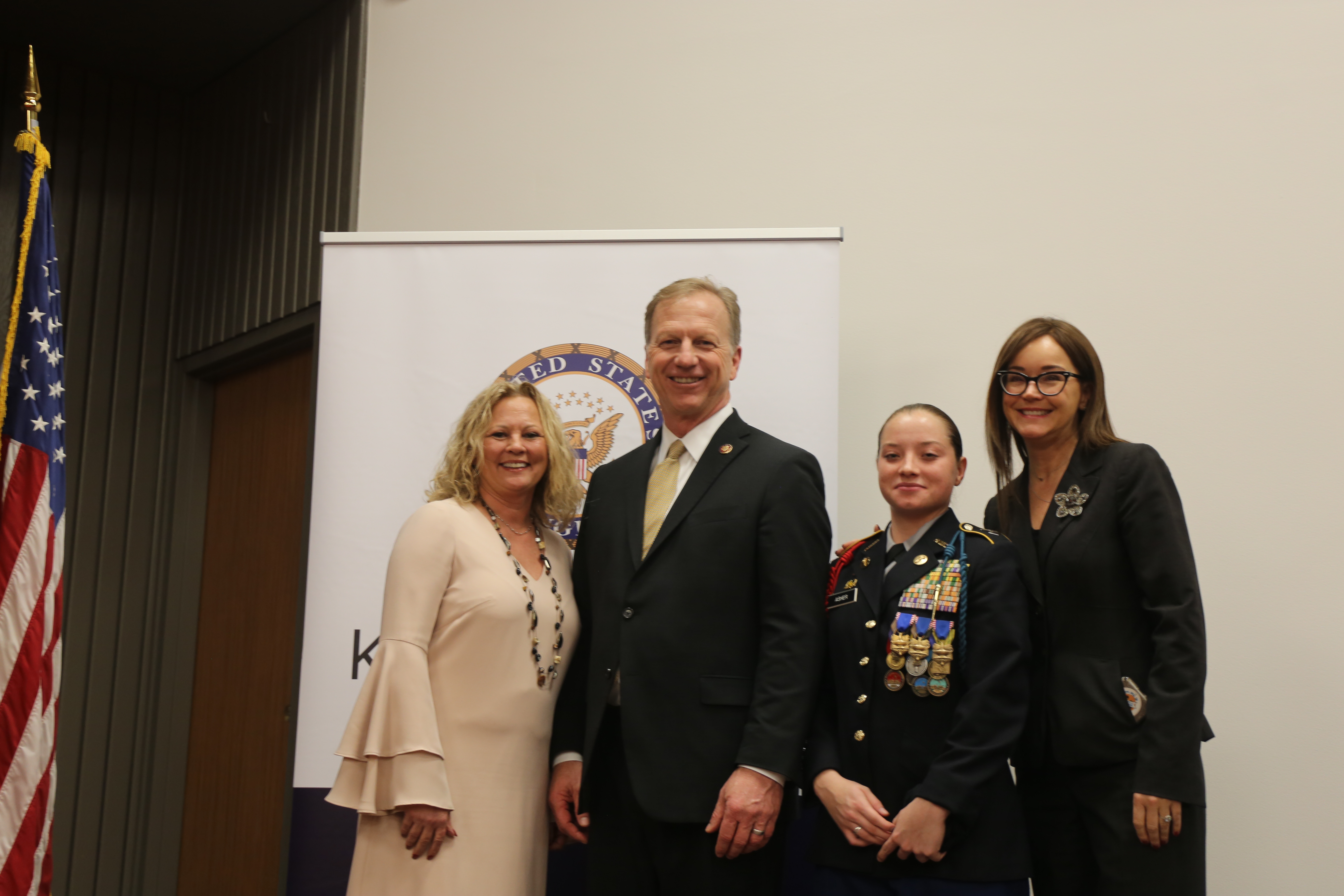
R to L: Nathan Hale Principal Dr. Sheila Riley, Rep. Kevin Hern, Savannah Asher, TPS Superintendent Dr. Deborah Gist
The students nominated to the United States Air Force Academy:
Grant Govrik, Bishop Kelley High School
Ella Austin, Bishop Kelley High School
Ash Harbert, Owasso High School
Doyle Gehring, Bishop Kelley High School
Avery Walton, Bixby High School
Kevin Glynn, Jenks High School
Savannah Asher, Nathan Hale High School
Connor Othon, Bishop Kelley High School
Bailey Lunsford, Homeschool
Clayton Florea, Collinsville High School
The students nominated to the United States Military Academy at West Point:
James Benjamin Payne, Bishop Kelley High School
Isaiah Hurst, Owasso High School
Logan De Los Santos, Cascia Hall High School
Hudson Mazzei, Jenks High School
Clayton Florea, Collinsville High
Ella Austin, Bishop Kelley High School
Grant Govrik, Bishop Kelley High School
Gregory Pitts, II, Owasso High School
The students nominated to the United States Naval Academy:
Meaghan Cyr, Bishop Kelley High School
Isabella Griffey, Jenks High School
Gregory Pitts, II, Owasso High School
Jake Weller, Cascia Hall High School
Stelios Boyaci, Edison High School
Joseph Pritchett, Holland Hall High School
Wanageeska Williams, Charles Page High School
Olivia Rauer, Bixby High School
Ash Harbert, Owasso High School
Clayton Florea, Collinsville High School
Logan De Los Santos, Cascia Hall High School
The students nominated to the United States Merchant Marines Academy:
Grant Govrik, Bishop Kelley High School
Gregory Pitts, II, Owasso High School
Monday, May 02, 2011
Details emerge regarding Bin Laden raid
As more time elapses, more details begin to emerge about the U.S. raid that killed Osama bin Laden in Abbottabad, Pakistan.
- The raid lasted roughly 40 minutes, and was carried out by SEAL Team Six (officially called the Naval Special Warfare Development Group).
- 22 people were killed or captured. No U.S. casualties. Osama bin Laden was killed by two shots to his left eye. Two Al-Qaeda couriers and one of Osama's sons were also killed, along with a woman being used as a human shield during the fighting.
- One of the two helicopters used for the raid had mechanical issues, and had to be crash-landed at the compound. The chopper was blown up when the SEALs left the area.
- Bin Laden's body was brought back with the SEAL team. Preliminary DNA testing confirms that it was Osama.
- Bin Laden was given a brief Islamic funeral ceremony aboard the USS Carl Vinson aircraft carrier, and then buried at sea.
- The compound was built in 2005, on approximately one acre. High walls surrounded the property, and were also present on upper floors of the building. The house had no telephone or internet service, and the residents burned their trash (instead of placing it out for collection, like their neighbors).
- Intelligence discovered the name of one of the couriers bin Laden was living with back in 2007. They found the courier in 2009, and the compound in August 2010.
- The original plan was to bomb the compound, but the President was told that there would be no evidence that could be recovered to prove Osama's death.
The Pentagon has released a briefing on the compound, viewable here (.pdf).
ABC's Jake Tapper is reporting that the Obama adminstration is debating on whether or not to release pictures of Bin Laden's body. "The argument against releasing the pictures: they’re gruesome. He has a massive head wound above his left eye where he took bullet, with brains and blood visible." [On that note, the photos currently floating around are 2 years old, and are fake]
After the news broke, crowds gathered across the country to celebrate. In particular, thousands came to the White House in Washington, D.C., Ground Zero in New York City, and President George W. Bush's house in Dallas. In Philadelphia, at the Phillies vs. Mets baseball game, fans chanted "USA! USA!" when the news began hitting attendees phones.
ABC has photos and video from inside the compound.
Thursday, June 24, 2010
USS Oklahoma Mast Arrives at Muskogee's War Memorial Park
"Honestly I didn't think we were going to get it here, but now that it's here, it's real," said Dennis. "It's just very exciting."
The USS Oklahoma was part of the fleet of American ships attacked at Pearl Harbor on December 7, 1941. The ship capsized within 12 minutes after being struck by Japanese torpedoes. 429 lives were lost when the ship went down, many trapped inside the submerged vessel. More than 65 years went by before an official memorial was erected to honor those fallen servicemen. The USS Oklahoma Memorial on Ford Island, Hawaii, was dedicated on December 7th, 2007.
State Rep. George Faught (R-Muskogee) began working on this project nearly 3 1/2 years ago. “There have been many ups and downs along the way, but we are thrilled that this valuable piece of history has finally arrived at the War Memorial Park," he said
Faught said his office first got involved when Rod Mish, a volunteer at the Park, contacted him to ask for help. Mish explained that early in 2007, he called the curator at the USS Arizona Memorial in Hawaii to see if any pieces from the USS Oklahoma were available for display in Muskogee's war museum. The curator told Mish that a section of the mast to the battleship had recently been discovered during a dredging operation at Pearl Harbor, but that the Navy was planning to cut it in pieces and dispose of it.
At the time Mish placed that phone call, his landlady, Judy Moody, was vacationing in Hawaii. He contacted her to see if she could take a look at the piece for him. She agreed, and the decision was then made by the War Memorial Park to pursue trying to acquire the mast for display at the museum.
Moody, a computer technology instructor at Northeastern State University, volunteered to fill out the appropriate paperwork, but soon discovered that there was a lot of "red tape" to get through. Since approval from the Navy was required, assistance was sought from Senator Tom Coburn's office, as well as that of Congressman Dan Boren. “Getting the Navy to relinquish the section of mast turned out to be a lengthy process,” said Moody.
Faught's office was tasked with arranging for transportation from Pearl Harbor to Muskogee. His legislative assistant just happened to be a long-time family friend of then Major General Loren Reno, the commander of the Oklahoma City Air Logistics Center at Tinker Air Force Base. This connection opened doors for possible transport in conjunction with training flights and other missions. "About 18 months ago, we thought we had a date set for a training flight from Hawaii, but then someone in the Navy decided to stall the project and the waiting game was back on", explained Faught.
Then they were notified that General Reno had received a promotion to the Pentagon. When he transferred, so did his assistant who had been heavily involved in making arrangements for the mast. So the process was once again delayed.
"Each completed step in the process revealed more hoops to jump through", said Faught, "and many delays seemed to take us back to square one."
But, not easily discouraged, museum director Rick Dennis, Moody and Faught continued to work on moving forward. Then, rather unexpectedly, earlier this month Moody received a phone call from a contact at Tinker Air Force Base, telling her that an Air National Guard training flight that could accommodate the large cargo had been scheduled and the mast was being crated for transport.
When the C-17 touched down at Tinker Air Force base on Monday, the four individuals who persevered were on hand to witness the mast arriving in Oklahoma. They were joined by USS Oklahoma survivor, Ed Vezey, 90, who recently moved to Moore, OK from Denver, CO. "This is a piece of the Oklahoma coming home,” Vezey said.
The mast was transported to Muskogee on Wednesday by the Oklahoma Air National Guard. As the truck pulled into the War Memorial Park bearing a banner that read “From Pearl Harbor to Muskogee – Mast of USS Oklahoma”, a crowd of around 50 people gathered in anticipation. Some had come specifically to see the mast arrive, but several groups just happened to be there, not knowing of the scheduled delivery.
The mast was offloaded by a crane from Cook Construction of Fort Gibson. The 45 ft. artifact weighs over 22,0000 pounds and is covered with barnacles from 65 years of being underwater. The piece from the mast is technically “on loan” from the U.S. Navy and is planned as the centerpiece of a new building that Dennis hopes to see built at the War Memorial Park. Preservation efforts will be performed on the mast and plans for establishing a foundation for the USS Oklahoma exhibit are being discussed.
“It took an awful lot of work,” stated Mish, recalling the journey over the past 3 ½ years.
"I am honored to have been a part of this project and to have played a role in bringing this to Muskogee. I look forward to helping the War Memorial Park expand this exhibit, commemorating the service and sacrifice of our armed forces,” stated Faught.
A dedication ceremony will take place on Saturday, July 10th at 10:00 a.m. The War Memorial Park will unveil the mast at that time. It is expected that numerous Pearl Harbor Survivors, including several from the USS Oklahoma will be in attendance, along with veterans groups, state officials and other dignitaries.
Thursday, November 12, 2009
Veterans Day - Congressional Heroes
There are three veterans in Congress that I want to highlight for you. These individuals have compelling stories to tell about their military experiences that fit right in with the Veterans Day spirit.
Without further ado, here are three American Heroes in Congress.
Much has been said about John McCain and his military experiences. Most of you already know his story. Here it is, taken from Wikipedia (for my sake!).
McCain entered the Navy during the Vietnam War. On July 29, 1967 McCain was injured when a bomb eploded onboard his aircraft carrier, getting struck in the legs and chest by shrapnel. On October 26, 1967, McCain was flying his twenty-third mission, he was shot down over Hanoi. His plane went into a vertical inverted spin. Bailing out upside down at high speed, the force of the ejection fractured McCain's right arm in three places, his left arm, and his right leg at the knee, and knocked him unconscious. McCain nearly drowned after parachuting into a Hanoi Lake. A Vietnamese mob pulled him from the water and attacked him. His left shoulder was crushed with the butt of a rifle and he was bayoneted in his left foot and abdominal area. He was then transported to the "Hanoi Hilton".
McCain was beaten upon entering the "Hanoi Hilton". Only when the North Vietnamese discovered that his father was a top admiral did they give him medical care. McCain gave the North Vietnamese his ship's name, squadron's name, and the attack's intended target. Further coerced to give future targets, he named cities that had already been bombed, and responding to demands for the names of his squadron's members, he supplied instead the names of the Green Bay Packers' offensive line. McCain spent six weeks in the hospital, receiving marginal care in a dirty, wet environment. A prolonged attempt to set the fractures on his right arm, done without anesthetic, was unsuccessful; he received an operation on his broken leg but no treatment for his broken left arm.
Now having lost fifty pounds, in a chest cast, covered in grime and eyes full of fever, and with his hair turned white, in early December 1967 McCain was sent to a prisoner-of-war camp on the outskirts of Hanoi nicknamed "the Plantation". In March 1968, McCain was put into solitary confinement, where he remained for two years. In mid-June, Major Bai, commander of the North Vietnamese prison camp system, offered McCain a chance to return home early. The North Vietnamese wanted to score a worldwide propaganda coup by appearing merciful, and also wanted to show other POWs that members of the elite like McCain were willing to be treated preferentially. McCain turned down the offer of release, due to the POWs' "first in, first out" interpretation of the U.S. Code of Conduct: he would only accept the offer if every man captured before him was released as well.
In late August 1968, a program of vigorous torture methods began on McCain. The North Vietnamese used rope bindings to put him into prolonged, painful positions and severely beat him every two hours, all while he was suffering from dysentery. His right leg was reinjured, his ribs were cracked, some teeth were broken at the gumline, and his left arm was re-fractured. After four days of this, McCain signed and taped an anti-American propaganda "confession". He used stilted Communist jargon and ungrammatical language to signal that the statement was forced. McCain was haunted then and since with the belief that he had dishonored his country, his family, his comrades and himself by his statement, but as he later wrote, "I had learned what we all learned over there: Every man has his breaking point. I had reached mine." Two weeks later his captors tried to force him to sign a second statement; his will to resist restored, he refused. He sometimes received two to three beatings per week because of his continued resistance; the sustained mistreatment went on for over a year. McCain refused to meet with various anti-Vietnam War peace groups coming to Hanoi, not wanting to give either them or the North Vietnamese a propaganda victory based on his connection to his father.
Altogether, McCain was held as a prisoner of war in North Vietnam for five and a half years, nearly five of them after his refusal to accept the out-of-sequence repatriation offer. His wartime injuries left him permanently incapable of raising either arm more than 80 degrees . For his actions as a POW, McCain was awarded the Silver Star, the Legion of Merit, three more instances of the Bronze Star, another instance of the Navy Commendation Medal, and the Purple Heart.
Whether you agree with his politics or not, John McCain is an American hero.
Sam Johnson is the least-well known of the three gentlemen that I am highlighting, but his story is every bit as real as the others. The following is taken from his congressional website (edited for brevity).
Johnson flew 62 combat missions during the Korean War, scoring one MiG fighter kill, one probable and one damaged. After Korea, he flew the solo and slot positions for the world-renowned Air Force Thunderbirds precision flying demonstration team in the F-100 Super Sabre.
In the Vietnam War during his second tour of duty, Johnson flew his 25th combat mission on April 16, 1966. Shot down at dusk over North Vietnam, Johnson suffered a broken right arm, dislocated left shoulder and a broken back. It was these injuries that the enemy captors would use in their constant efforts to glean information from Johnson.
Johnson spent nearly seven years as a prisoner of war, 42 months in solitary confinement. Forced into solitary when his captors labeled him a “die-hard,” Johnson committed 374 names to memory from tapping a special code on the prison wall. “We were all trying to memorize names in case anybody got out,” Johnson remembers.
While held in the infamous Hanoi Hilton, Johnson spent 72 days in leg stocks. A day after that torture ended, his captors forced him into leg irons for 2 ½ years. Weighing 200 lbs when shot down, an emaciated Johnson got down to an estimated 120 lbs while barely surviving on the occasional “meal” of weeds from the river, pig fat, white rice, or pumpkin soup.
Fellow POW Capt. James Mulligan, USN (Ret.) recalled the day Johnson was allowed to return to a joint cell. He walked into the room with the two other detained American officers, “stood at attention with tears in his eyes, and said simply, ‘Lieutenant Colonel Sam Johnson reporting for duty, sir’…after he had not talked to or directly been with an American for three and a half years.”
Whether you agree with his politics or not, Sam Johnson is an American hero.
As you can tell from the above picture, Sen. Inouye does not have a right arm.
You see, Inouye was a soldier in the all Japanese-American 442nd Regimental Combat Team, the most highly-decorated unit in Army history. Since Americans of Japanese descent were suspected of Axis sympathies (many were held in internment camps), members of the 442nd often volunteered for suicide missions in the European theater to prove how American they were. The following is again from Wikipedia.
In 1943, when the U.S. Army dropped its ban on Japanese-Americans, Inouye curtailed his premedical studies at the University of Hawaii and enlisted in the Army. Inouye was promoted to the rank of sergeant within his first year, and he was given the role of platoon leader. He served in Italy in 1944 during the Rome-Arno Campaign before he was shifted to the Vosges Mountains region of France, where he spent two weeks searching for the Lost Battalion, a Texas battalion that was surrounded by German forces. He was promoted to the rank of second lieutenant for his actions there. At one point while leading an attack a shot struck him in the chest directly above his heart, but the bullet was stopped by the two silver dollars he happened to have stacked in his shirt pocket. He continued to carry the coins throughout the war in his shirt pocket as good luck charms.
On April 21, 1945, Inouye was grievously wounded while leading an assault on a heavily-defended ridge called near Terenzo called Colle Musatello. The ridge served as a strongpoint along the strip of German fortifications known as the Gothic Line, which represented the last and most dogged line of German defensive works in Italy. As he led his platoon in a flanking maneuver, three German machine guns opened fire from covered positions just 40 yards away, pinning his men to the ground. Inouye stood up to attack and was shot in the stomach; ignoring his wound, he proceeded to attack and destroy the first machine gun nest with hand grenades and fire from his M1 Thompson submachine gun. After being informed of the severity of his wound by his platoon sergeant, he refused treatment and rallied his men for an attack on the second machine gun position, which he also successfully destroyed before collapsing from blood loss.
As his squad distracted the third machine gunner, Inouye crawled toward the final bunker, eventually drawing within 10 yards. As he raised himself up and cocked his arm to throw his last grenade into the fighting position, a German inside fired a rifle grenade that struck him on the right elbow, severing most of his arm and leaving the primed grenade reflexively "clenched in a fist that suddenly didn't belong to me anymore". Inouye's horrified soldiers moved to his aid, but he shouted for them to keep back out of fear his severed fist would involuntarily relax and drop the grenade. As the German inside the bunker reloaded his rifle, Inouye managed to successfully pry the live grenade from his useless right hand and transfer it to his left. As the German aimed his rifle to finish him off, Inouye managed at last to toss the grenade off-hand into the bunker and destroy it. He stumbled to his feet and continued forward, silencing the last German resistance with a one-handed burst from his Thompson before being wounded in the leg and tumbling unconscious to the bottom of the ridge. When he awoke to see the concerned men of his platoon hovering over him, his only comment before being carried away was to gruffly order them return to their positions, since, as he pointed out, "nobody had called off the war".
The remainder of Inouye's mutilated right arm was later amputated at a field hospital without proper anesthesia, as he had been given too much morphine at an aid station and it was feared any more would lower his blood pressure enough to kill him. Inouye was initially awarded the Distinguished Service Cross for his bravery in this action, with the award later being upgraded to the Medal of Honor (alongside 21 other Nisei servicemen who served in the 442nd Regimental Combat Team and were believed to have been denied proper recognition of their bravery due to their race).
While recovering from WWII wounds and the amputation of his right forearm from the grenade wound (mentioned above) at Percy Jones Army Hospital, Inouye met future Republican presidential candidate Bob Dole, then a fellow patient. Dole mentioned to Inouye that after the war he planned to go to Congress; Inouye beat him there by a few years. The two have remained lifelong friends. In 2003, the hospital was renamed the Hart-Dole-Inouye Federal Center in honor of the two WWII veterans and another U.S. Senator and fellow WWII veteran who had stayed in the hospital, Philip Hart.
Whether you agree with his politics or not, Daniel Inouye is an American hero.
And then finally, I end with this poem, which has been passed around so much that nobody really knows who the author is (often attributed to one Father Dennis Edward O'Brien, of the USMC):
who has given us freedom of the press.
It is the soldier, not the poet,
who has given us freedom of speech.
It is the soldier, not the campus organizer,
who has given us the freedom to demonstrate.
It is the soldier, not the lawyer,
who has given us the right to a fair trial.
It is the soldier,
who salutes the flag,
who serves under the flag,
and whose coffin is draped by the flag,
who allows the protester to burn the flag.
Top Blog List
-
-
-
-
Tuesday's Final Word1 day ago
-
City of Tulsa ONG franchise renewal2 days ago
-